
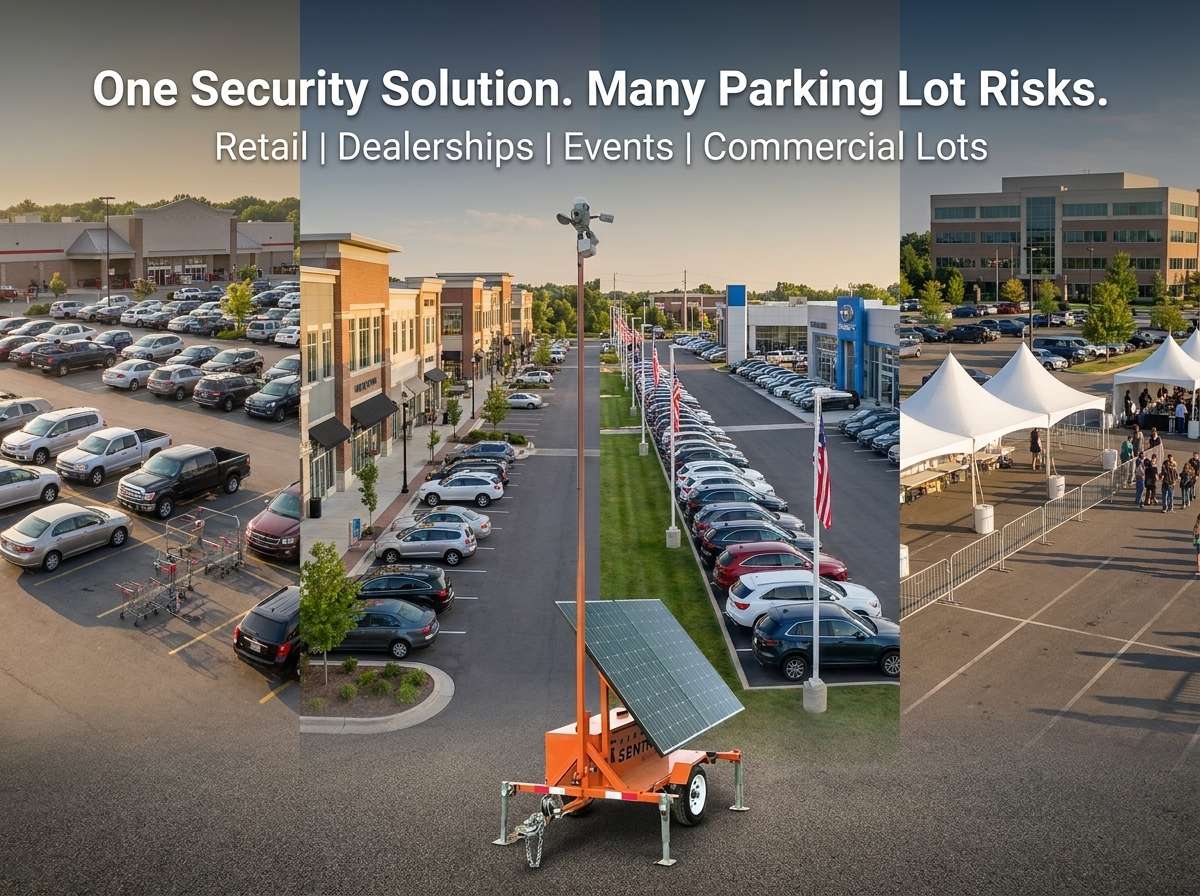
A parking lot is often the first place a customer, employee, vendor, or visitor experiences your property. It is also one of the easiest areas to overlook.
Retailers, shopping centers, big-box stores, dealerships, event venues, commercial buildings, and outdoor lots often focus security inside the building. But many problems start outside, in the parking area.
Vehicles sit unattended. Customers walk alone. Employees leave after dark. Deliveries happen near side entrances. Loitering can develop near corners. Lighting may not cover the full lot. Cameras may not capture license plates, blind spots, or activity near the perimeter.
That is why parking lot security matters.
For many properties, the question becomes: should we use a security guard, a mobile surveillance unit, or both?
The short answer is simple. Security guards are useful when you need human interaction, patrols, and on-site response. Mobile surveillance units are usually stronger when you need wide-area visibility, visible deterrence, recorded video evidence, remote monitoring, and flexible coverage across a large outdoor space.
For large parking lots, shopping centers, big-box retail lots, dealerships, and event parking areas, mobile surveillance units can often become the foundation of a stronger security plan.
Why Parking Lot Security Matters
Parking lots are open, busy, and difficult to control. Unlike the inside of a store or building, a parking lot has multiple access points, moving vehicles, pedestrians, blind spots, and areas where people can enter or leave quickly.
Parking lot security is not only about preventing crime. It is also about reducing confusion after an incident, improving customer confidence, helping employees feel safer, and giving property managers better information.
- Vehicle break-ins
- Auto theft
- Catalytic converter theft
- Vandalism
- Loitering
- Trespassing
- Unauthorized overnight parking
- Illegal dumping
- Customer or employee safety concerns
- Delivery disputes
- Slip, trip, and fall claims
- Accidents involving pedestrians and vehicles
The National Insurance Crime Bureau reported that U.S. vehicle thefts dropped 17% in 2024, falling below the one million mark for the first time since 2021. Even with that improvement, parking lots remain exposed because vehicles are parked in open areas for long periods. [1]
The National Highway Traffic Safety Administration also notes that more than 850,000 vehicles were stolen in the United States in 2024 and that summer is the worst season for vehicle theft. [2]
The Office of Justice Programs CPTED guide identifies lighting as one of the most important security features in the built environment. Parking facilities and open lots become more vulnerable when visibility and control are weak. [3]
What Makes Parking Lots Hard to Secure?
Parking lots are not like indoor spaces. They are wider, less controlled, and more unpredictable.
A retail parking lot may have customers entering and leaving all day. A shopping center may have multiple tenants and shared responsibility. A dealership may have vehicles worth thousands or millions of dollars sitting outside overnight. An event venue may have a sudden rush of cars, pedestrians, vendors, and temporary staff. A commercial lot may be quiet during the day but exposed after hours.
- Large open areas
- Multiple entrances and exits
- Poor lighting in corners or back rows
- Blind spots behind vehicles, dumpsters, trailers, or landscaping
- Limited employee visibility from inside the building
- Unclear camera coverage
- No permanent power in some areas
- No easy way to move fixed cameras as risk changes
- Delayed incident discovery
- Lack of clear video evidence
A parking lot can look calm during business hours and become vulnerable at night. That is why modern parking lot security needs more than a sign, a light pole, or occasional patrol.
People Also Ask: What Is the Best Way to Secure a Retail Parking Lot?
The best way to secure a retail parking lot is to combine strong lighting, visible cameras, mobile surveillance units, clear signage, controlled access where possible, regular patrols, and recorded video evidence. The goal is to make the lot look active, monitored, and difficult to target.
A strong parking lot security plan should answer four questions:
- Can people clearly see where they are walking and parking?
- Can the property team see what is happening in real time?
- Can suspicious activity be discouraged before it turns into an incident?
- Can footage show what happened if something goes wrong?
If the answer is no, the lot needs stronger security coverage.
Security Guard vs. Mobile Surveillance Unit: Quick Comparison
| Category | Security Guard | Mobile Surveillance Unit | Better Option |
| Customer interaction | Strong | Limited | Security Guard |
| Employee escort support | Strong | Limited | Security Guard |
| Wide-area visibility | Limited by patrol route | Strong | Mobile Surveillance Unit |
| Recorded evidence | Only if cameras are present | Strong | Mobile Surveillance Unit |
| After-hours monitoring | Expensive if staffed all night | Strong | Mobile Surveillance Unit |
| Visible deterrence | Human presence | Cameras, lights, tower visibility | Both |
| Remote access | Limited | Strong | Mobile Surveillance Unit |
| Multi-site scalability | Requires more staff | Easier to scale | Mobile Surveillance Unit |
| Cost predictability | Can rise with hours and shifts | Often more predictable | Mobile Surveillance Unit |
| Best use case | Human response and patrol | Monitoring, deterrence, evidence | Depends on property needs |
What Security Guards Do Well in Parking Lots
Security guards still have value in parking lot security.
A guard can walk the property, speak with people, check suspicious activity, escort employees, help customers, report hazards, and respond to situations that require human judgment.
- Customer support
- Employee escorts after dark
- Vehicle patrols
- Responding to suspicious behavior
- Managing event parking
- Helping during peak traffic
- Supporting store opening and closing
- Communicating with law enforcement
- Enforcing property rules
For some properties, especially high-traffic retail centers or event venues, a guard can be a helpful part of the security plan. But guards also have limits.
A single guard cannot watch every row, entrance, side lot, loading area, and blind spot at once. If the guard is helping a customer near the front entrance, they may miss activity near the back row. If the guard is driving one side of the lot, they may not see a vehicle break-in on the other side. That is where mobile surveillance becomes important.
What Mobile Surveillance Units Do Well in Parking Lots
A mobile surveillance unit is a portable outdoor security platform that can be positioned in high-risk parking areas. It may include cameras, lights, remote access, recording, motion detection, cellular connectivity, solar power, battery support, and audio warning capability.
For parking lots, mobile surveillance units are useful because they are visible, flexible, and built for outdoor environments.
- Parking lot entrances
- Main traffic lanes
- Customer parking areas
- Employee parking areas
- Loading zones
- Overflow parking
- Event parking
- Dealership vehicle rows
- Dark corners
- Perimeter areas
- Unauthorized gathering areas
- Outdoor storage areas
A mobile surveillance unit can also be moved as the property changes. If theft activity starts near one corner, the unit can be placed there. If an event is happening, it can watch event parking. If a dealership receives new inventory, the unit can monitor that area overnight. That flexibility is hard to match with fixed cameras alone.
People Also Ask: Are Mobile Surveillance Units Good for Parking Lots?
Yes. Mobile surveillance units are good for parking lots because they provide visible deterrence, flexible camera placement, remote viewing, recorded footage, and lighting support. They are especially useful for large retail lots, dealership lots, event lots, shopping centers, commercial properties, and areas without easy access to permanent power or internet.
Why Video Evidence Matters in Parking Lot Security
After a parking lot incident, the first question is usually: what happened?
Without footage, property managers may be left relying on witness statements, customer complaints, employee reports, or assumptions.
Video evidence can help answer:
- Who entered the area?
- What vehicle was involved?
- What time did the incident happen?
- Which direction did someone come from?
- Was there a break-in, accident, theft, or vandalism?
- Did the incident happen on the property or nearby?
- Was the lighting adequate?
- Were employees or customers present?
- Did a delivery or vendor arrive?
- Is there footage that can support a report or claim?
Video evidence can support police reports, insurance claims, internal reviews, vendor disputes, and liability documentation. OSHA workplace violence prevention guidance recommends that businesses consider security measures such as video surveillance, lighting, alarm systems, and access controls where appropriate. OSHA also asks employers to evaluate whether parking and outside areas have enough lighting for people to see clearly. [4]
Parking Lot Security for Big-Box Stores and Shopping Centers
Big-box stores and shopping centers have unique parking lot security challenges.
- Large parking fields
- High traffic volume
- Customers coming and going quickly
- Employees working early or late shifts
- Delivery trucks
- Cart corrals
- Multiple entrances
- Seasonal traffic spikes
- Areas far from the main building
- Shared tenant responsibility
A single fixed camera near the entrance may not be enough. The outer rows, side lots, loading areas, and overflow parking can become blind spots. Mobile surveillance units help because they can create a visible security presence in the lot itself, not just on the building.
For big-box retail properties, a mobile unit can be placed near outer parking rows, high-theft areas, employee parking, loading zones, seasonal outdoor displays, garden centers, truck access points, overnight parking areas, and temporary event zones.
Parking Lot Security for Car Dealerships
Car dealerships are one of the strongest use cases for mobile surveillance.
A dealership lot may contain hundreds of vehicles, many of them high-value and exposed overnight. Risks can include vehicle theft, key theft, vandalism, wheel theft, catalytic converter theft, break-ins, and unauthorized access.
- Vehicle inventory rows
- Service parking
- Customer drop-off areas
- Back lots
- Gate areas
- Delivery zones
- Perimeter fencing
- High-value inventory areas
The value of video evidence is especially high for dealerships because one incident can involve expensive property damage or vehicle loss. A mobile surveillance unit gives dealership managers a visible deterrent during closed hours and a way to review footage if something happens overnight.
Parking Lot Security for Event Venues
Event parking creates a different challenge. For a few hours, a quiet lot can become crowded with vehicles, pedestrians, vendors, temporary staff, and ride-share traffic. After the event, the same area may quickly become empty again.
Event lots may need temporary security because fixed infrastructure is not always available.
- Temporary parking zones
- Pedestrian walkways
- Vendor entrances
- VIP parking
- Staff parking
- Loading areas
- Crowd movement
- After-event clearing
- Unauthorized access after closing
Because mobile units can be deployed temporarily, they are useful for concerts, festivals, sporting events, outdoor markets, and seasonal attractions.
Parking Lot Security for Commercial Properties
Office buildings, medical centers, warehouses, hotels, schools, multifamily communities, and commercial buildings all have parking security concerns. A commercial parking lot may need to protect employees, visitors, fleet vehicles, delivery areas, and after-hours access points.
- Employee parking safety
- Visitor parking oversight
- Fleet vehicle monitoring
- Delivery documentation
- After-hours security
- Vandalism prevention
- Illegal dumping prevention
- Gate and entrance visibility
The goal is not to make the property feel aggressive or over-policed. The goal is to make it feel managed, visible, and secure.
People Also Ask: Do Parking Lots Need Security Cameras?
Yes. Parking lots should have security cameras because they are open areas where vehicles, pedestrians, employees, customers, and property are exposed. Cameras can help deter theft, document incidents, support investigations, and improve visibility across high-risk areas.
However, camera placement matters. A camera that cannot see the right area, capture useful details, or record clearly may not help when an incident occurs. Parking lot camera coverage should focus on entrances, exits, vehicle rows, pedestrian paths, loading areas, employee parking, and blind spots.
Lighting Is the First Layer of Parking Lot Security
Lighting is one of the most important parts of parking lot security.
Poor lighting creates fear, reduces visibility, weakens camera footage, and makes it easier for suspicious activity to go unnoticed.
The Whole Building Design Guide notes that energy-efficient lighting is very important in facility safety, while also requiring careful design so light does not create glare or spillover problems. [5]
Good lighting helps customers feel safer, supports clearer footage, helps security teams see activity faster, and makes suspicious behavior more visible. Lighting alone is not enough, but it is one of the strongest foundations for parking lot safety and security.
Where Should Mobile Surveillance Units Be Placed in a Parking Lot?
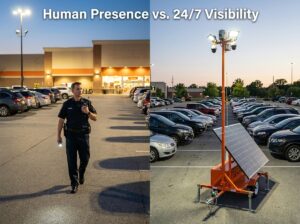
A mobile surveillance unit should be placed where it can cover the highest-risk areas and remain clearly visible.
- Main lot entrance
- High-traffic driving lanes
- Employee parking
- Dark corners
- Outer parking rows
- Loading zones
- Overflow parking
- Event parking areas
- Dealership inventory rows
- Areas with past incidents
- Perimeter access points
- Illegal dumping areas
Placement should not be random. It should be based on risk. Property managers should ask:
- Where have incidents happened before?
- Where is lighting weakest?
- Where do people gather after hours?
- Where are vehicles most exposed?
- Which areas are hardest to see from the building?
- Where would a camera create the strongest deterrent?
The best mobile surveillance strategy is flexible. As risks change, the unit can move.
Parking Lot Security in Phoenix, Dallas, Houston, Austin, Denver, and Other High-Risk Markets
Parking lot security is especially important in fast-growing markets where retail centers, dealerships, event venues, commercial lots, and large parking areas see heavy vehicle traffic every day.
Cities like Phoenix, Dallas, Houston, Austin, Denver, Atlanta, Nashville, Tampa, Orlando, Miami, Las Vegas, and Charlotte have active commercial growth, busy retail corridors, event spaces, and large outdoor parking areas. These properties often need security solutions that can cover wide spaces, adapt to changing risk, and provide reliable video evidence after an incident.
For property managers searching for Phoenix parking lot security, Dallas parking lot security, Houston parking lot surveillance trailers, Austin mobile surveillance trailers, or Denver parking lot security cameras, the goal is usually the same: protect vehicles, customers, employees, and outdoor property without relying only on traditional guard patrols.
A mobile surveillance trailer or solar surveillance trailer can be placed in high-risk areas such as outer parking rows, loading zones, dealership inventory areas, employee parking, event parking, and dark corners. This gives property owners stronger visibility, better deterrence, and remote video monitoring where fixed cameras may not be enough.
Best Parking Lot Security Setup
The strongest parking lot security strategy uses multiple layers.
Start with good lighting. Add visible cameras. Use mobile surveillance units in high-risk areas. Place clear signage at entrances and throughout the lot. Keep landscaping trimmed to reduce hiding spots. Monitor employee parking and loading areas. Review footage after incidents. Adjust placement based on past activity.
A strong parking lot security setup should include:
- Bright, even lighting
- Mobile surveillance units
- Visible security cameras
- Recorded video footage
- Clear warning signage
- Remote monitoring access
- Regular patrols when needed
- Trimmed landscaping
- Clear sightlines
- Incident response procedures
- Police reporting process
- Employee safety procedures
Security is strongest when every layer supports the next one.
Security Guard vs. Mobile Surveillance Unit: Which Is Better for Parking Lots?
For most parking lots, mobile surveillance units are the better foundation because they provide visibility, deterrence, recording, remote access, and flexible placement.
Security guards are still useful when the property needs direct human response, customer support, employee escorts, or event crowd management.
The best answer is not always one or the other.
| Best Practical Setup |
| Use mobile surveillance for visibility, deterrence, and video evidence. Use security guards where human interaction and response are truly needed. |
That approach gives property owners stronger coverage without relying only on a person walking or driving the lot.
Why Jobsite Sentry?
Jobsite Sentry helps protect more than construction sites.
Our mobile surveillance solutions are built for outdoor spaces where visibility, deterrence, and video evidence matter.
Jobsite Sentry can help protect:
- Retail parking lots
- Shopping centers
- Big-box store parking areas
- Car dealerships
- Commercial lots
- Event parking areas
- Equipment yards
- Storage yards
- Fenced properties
- Utility sites
- Solar sites
- Vacant outdoor assets
With Jobsite Sentry, property managers do not have to wonder what happened after an incident. They can review footage, monitor high-risk areas, and stay more informed from anywhere.
What Does One Parking Lot Incident Cost?
One parking lot incident can cost far more than the damage itself.
A vehicle break-in, theft, catalytic converter theft, vandalism, slip-and-fall claim, employee injury, or customer safety incident can create multiple costs at once. Property managers may have to deal with repairs, insurance claims, police reports, customer complaints, lost trust, legal exposure, and time spent reviewing what happened.
One incident may involve:
- Vehicle damage
- Stolen property
- Insurance claim paperwork
- Employee safety concerns
- Customer complaints
- Liability questions
- Police reporting
- Lost time for managers
- Reputation damage
- Increased pressure to improve security
This is why prevention often costs less than reaction.
A visible parking lot surveillance trailer, strong lighting, recorded footage, and remote video monitoring can help reduce confusion after an incident and make the property harder to target in the first place. Instead of waiting until something happens, property owners can create a security presence that helps deter problems and provides evidence when incidents occur.
Just Remember
Parking lots are not just empty space around a building. They are active, exposed areas where customers, employees, vehicles, vendors, and property all come together.
That makes them a major security priority.
Security guards can help with patrols, customer support, employee escorts, and human response. But mobile surveillance units provide the visibility, deterrence, recorded evidence, and flexible coverage that large parking lots need.
For retail properties, shopping centers, dealerships, event venues, and commercial outdoor lots, mobile surveillance is one of the smartest ways to strengthen parking lot security.
| Do not wait until after a parking lot incident to wish you had footage. See your lot. Protect your property. Stay in control with Jobsite Sentry. Get Mobile Surveillance |
FAQ
What is the best way to secure a parking lot?
The best way to secure a parking lot is to use layered security, including strong lighting, visible cameras, mobile surveillance units, clear signage, remote monitoring, and a response plan.
Are mobile surveillance units good for parking lots?
Yes. Mobile surveillance units are useful for parking lots because they provide visible deterrence, flexible placement, remote viewing, recorded footage, and lighting support.
Do parking lots need security cameras?
Yes. Parking lots should have security cameras because they are open areas where vehicles, pedestrians, customers, employees, and property are exposed to theft, vandalism, accidents, and safety concerns.
Where should cameras be placed in a parking lot?
Parking lot cameras should cover entrances, exits, driving lanes, pedestrian walkways, employee parking, loading zones, outer parking rows, dealership inventory rows, and blind spots.
Can security cameras prevent parking lot crime?
Security cameras can help deter crime by making the property look monitored. They also provide video evidence if an incident happens. Cameras work best when combined with lighting, signage, monitoring, and response procedures.
Are security guards better than mobile surveillance units?
Security guards are better for human interaction, customer support, patrols, and employee escorts. Mobile surveillance units are better for wide-area visibility, video recording, remote access, and after-hours monitoring.
What is the best security solution for a retail parking lot?
The best solution for a retail parking lot is usually a combination of mobile surveillance units, visible cameras, strong lighting, signage, remote monitoring, and guards when human response is needed.
How can shopping centers improve parking lot security?
Shopping centers can improve parking lot security by adding better lighting, visible cameras, mobile surveillance units, clear signage, trimmed landscaping, monitored employee parking, and clear incident response procedures.
How can car dealerships protect vehicles after hours?
Car dealerships can protect vehicles after hours by using perimeter lighting, locked gates, mobile surveillance units, cameras covering inventory rows, remote monitoring, key control, and incident review procedures.
Why is parking lot lighting important for security?
Lighting improves visibility, helps people feel safer, supports clearer camera footage, and makes suspicious activity easier to detect. Poor lighting can create blind spots and increase risk.
Can parking lot video footage help with insurance claims?
Yes. Video footage can help document what happened, when it happened, what vehicle or person was involved, and which area was affected. This can support police reports, insurance claims, and internal reviews.
What businesses need parking lot security?
Retail stores, shopping centers, big-box stores, car dealerships, event venues, commercial buildings, hotels, medical centers, schools, warehouses, multifamily properties, and outdoor lots can all benefit from parking lot security.
Sources and Authority References
[1] National Insurance Crime Bureau – Vehicle Thefts in the United States Fell 17% in 2024. Used for 2024 national vehicle-theft trend data. https://www.nicb.org/news/news-releases/vehicle-thefts-united-states-fell-17-2024
[2] National Highway Traffic Safety Administration – Vehicle Theft Prevention. Used for 2024 theft volume context and prevention campaign reference. https://www.nhtsa.gov/vehicle-safety/vehicle-theft-prevention
[3] Office of Justice Programs – Crime Prevention Through Environmental Design. Used for CPTED and lighting/security design context. https://www.ojp.gov/pdffiles/cptedpkg.pdf
[4] OSHA – Guidelines for Preventing Workplace Violence for Healthcare and Social Service Workers. Used for workplace security analysis, lighting, video surveillance, alarms, and access-control considerations. https://www.osha.gov/sites/default/files/publications/OSHA3148.pdf
[5] Whole Building Design Guide – Parking Facilities. Used for parking facility lighting and safety design context. https://www.wbdg.org/article/building-types/parking-facilities
[6] Canadian Centre for Occupational Health and Safety – Parking Lot Safety. Used for practical parking lot safety considerations such as cameras, lighting, visibility, and security personnel. https://www.ccohs.ca/oshanswers/psychosocial/violence/violence_parking_lot.html