Apartment Renovation Site Access Control After Hours

A practical guide for multifamily owners, property managers, renovation teams, and contractors managing after-hours access without losing control of the property
Apartment renovation sites are rarely simple to secure. A ground-up job may have one fence line, one gate, and one controlled work area. A multifamily renovation can have occupied units, vacant units, open breezeways, temporary fencing, contractor parking, delivery routes, resident paths, leasing staff, maintenance teams, and emergency vendors all moving through the same property.
That overlap creates the real problem: after-hours access. A plumber may need to finish a shutoff repair at 8 p.m. A superintendent may need to inspect a unit before a morning turnover. A vendor may need to deliver materials before the parking lot fills with residents. At the same time, the owner has to keep out trespassers, copper thieves, vandals, unauthorized workers, and anyone using an old access code after the site is closed.
Effective apartment renovation site access control is not only a gate, a lockbox, or a camera. It is a documented system for deciding who belongs on the property, when access is allowed, which areas are open, how activity is verified, and what happens when someone enters outside the approved schedule.
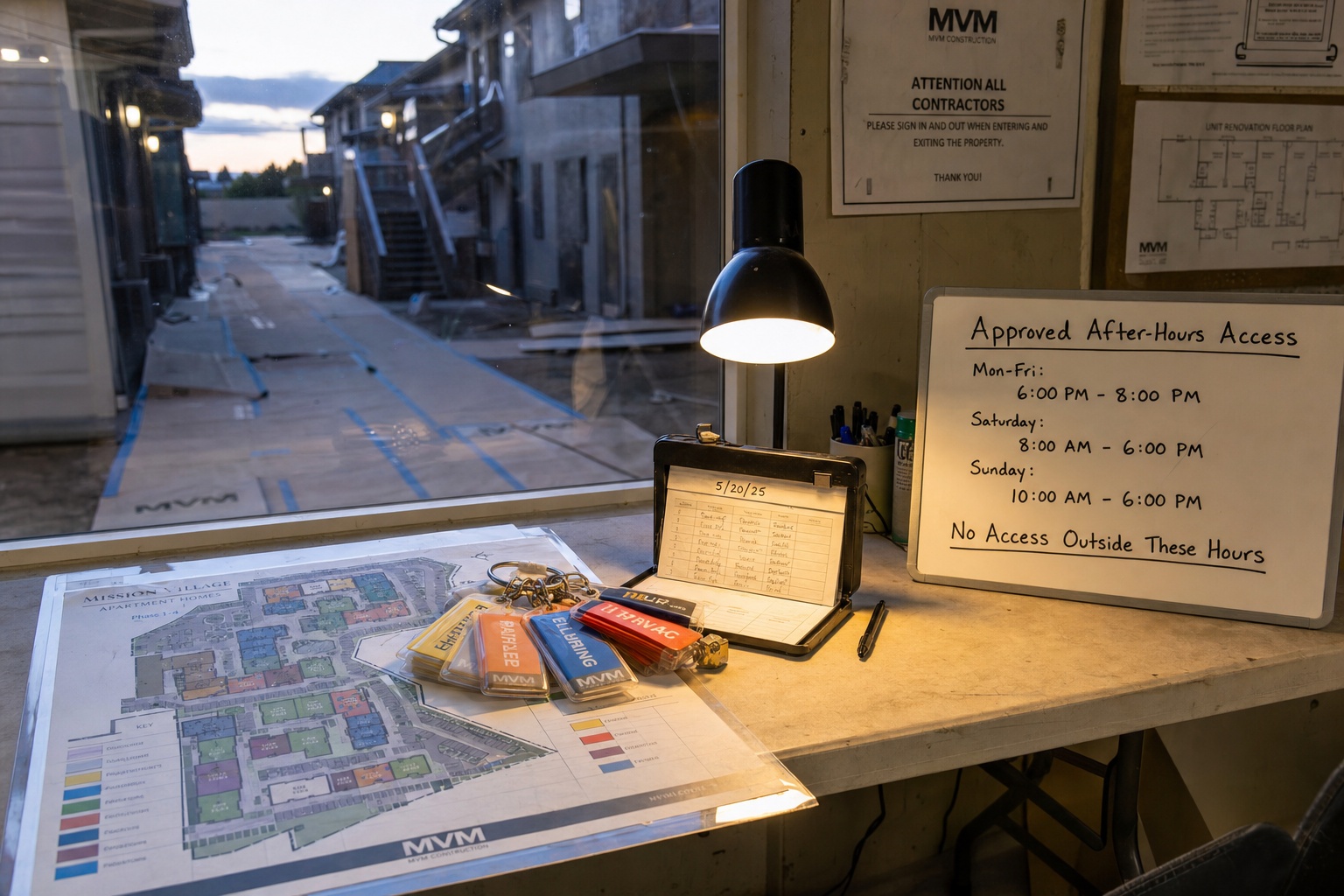
| Quick answer Apartment renovation site access control works best when the project team maps every entry point, defines approved after-hours users, limits access by time and area, uses live monitored cameras at high-risk zones, and follows a written escalation protocol. The goal is not to block legitimate emergency work. The goal is to know who is on the property, why they are there, and whether their activity matches the approved access plan. |
| Access control layer | What it solves | What to verify |
| Access map | Shows where residents, contractors, deliveries, and maintenance can enter or overlap. | Every gate, stairwell, breezeway, vacant wing, delivery route, and resident-facing area is listed. |
| Approved access windows | Separates expected activity from suspicious after-hours movement. | Each role has a clear time window, route, and authorized area. |
| Live monitored cameras | Allows activity to be reviewed while it is happening, not only the next morning. | Coverage captures approaches, exits, and high-risk access points. |
| Exception process | Allows emergency work without opening the entire site to everyone. | Each exception names the person, company, time, area, approver, and monitoring note. |
| Escalation protocol | Tells operators and managers what to do when activity does not match the schedule. | Contacts, audio warning rules, law enforcement criteria, and clip export rules are current. |
Why After-Hours Access Is Harder at Apartment Renovation Sites
A stabilized apartment community has routines. Residents know where to park, vendors use established access instructions, the leasing office has normal hours, and maintenance routes are usually understood. A renovation site interrupts those routines.
One building may be occupied while the next is under renovation. A contractor may be working behind plastic sheeting in an interior corridor while residents are still using the parking lot outside. Temporary construction entrances may sit close to resident doors, package rooms, mailboxes, dumpsters, and amenities. That creates ambiguity after hours.
Ambiguity is dangerous because unauthorized activity can look legitimate for the first few seconds. A person carrying tools might be an approved maintenance technician, a subcontractor returning without permission, or someone using construction access as cover. A vehicle near a vacant building might be a scheduled delivery, a resident parked in the wrong area, or a theft attempt.
The access-control plan has to give the monitoring team context. It should explain what activity is expected, what areas are closed, who is allowed after hours, and which situations require immediate escalation.
The most common after-hours access problems
| Problem | Why it matters | Better control |
| Shared codes spread across trades | Old codes may remain active after a vendor, worker, or phase is finished. | Rotate codes, limit distribution, and pair access with video verification. |
| Contractors return without approval | Late work may be legitimate, but unannounced access creates confusion and liability. | Require written approval for each after-hours work window. |
| Residents enter construction zones | Residents may use shortcuts through closed breezeways, garages, or vacant wings. | Use signage, barriers, lighting, resident notices, and camera coverage at transition points. |
| Materials are delivered to unsecured areas | After-hours delivery drops can leave appliances, fixtures, or tools exposed. | Define one approved drop zone, route, contact person, and camera view. |
| Emergency maintenance is not communicated | A valid emergency call may trigger a security response if it is not on the schedule. | Create a separate emergency-only access rule and contact list. |
Passive cameras are not enough when the site needs a response
Record-only cameras can be useful after an incident, but they do not challenge a trespasser, warn a person away from a vacant wing, notify a project lead, or create a real-time response. Live monitored cameras add context and action. When activity is detected in an approved zone during monitored hours, trained operators can review the video, compare it with the schedule, issue an audio warning when appropriate, contact the right person, and escalate under the approved protocol.
Start With an Access Map, Not a Camera List
The first step is not choosing camera locations. It is mapping movement. Apartment renovation sites often have more entry points than the team realizes, especially once resident paths, contractor shortcuts, delivery routes, and emergency access are included.
Start with vehicle gates, pedestrian gates, stairwells, breezeways, vacant building entrances, roof access, maintenance rooms, pool gates, dumpsters, leasing office routes, parking areas, and material delivery points. Then decide which of those areas should remain open after hours, which should be restricted, and which should be treated as emergency-only.
This map becomes the foundation for camera placement, monitoring schedules, detection zones, authorized activity notes, and escalation rules. Without it, the team is guessing.
Place Image 2 Here
| Access point | Risk to review | Camera placement note |
| Contractor gate | After-hours entry, old codes, unplanned vendors, vehicle access. | Capture the gate approach, vehicle path, and route toward resident-facing areas. |
| Vacant building wing | Trespassing, theft, unauthorized work, resident shortcuts. | Cover stairwells, exterior approaches, and transition points into closed zones. |
| First-floor breezeways | Easy entry, limited visibility, resident and contractor overlap. | Position cameras to see both direction of travel and door approaches. |
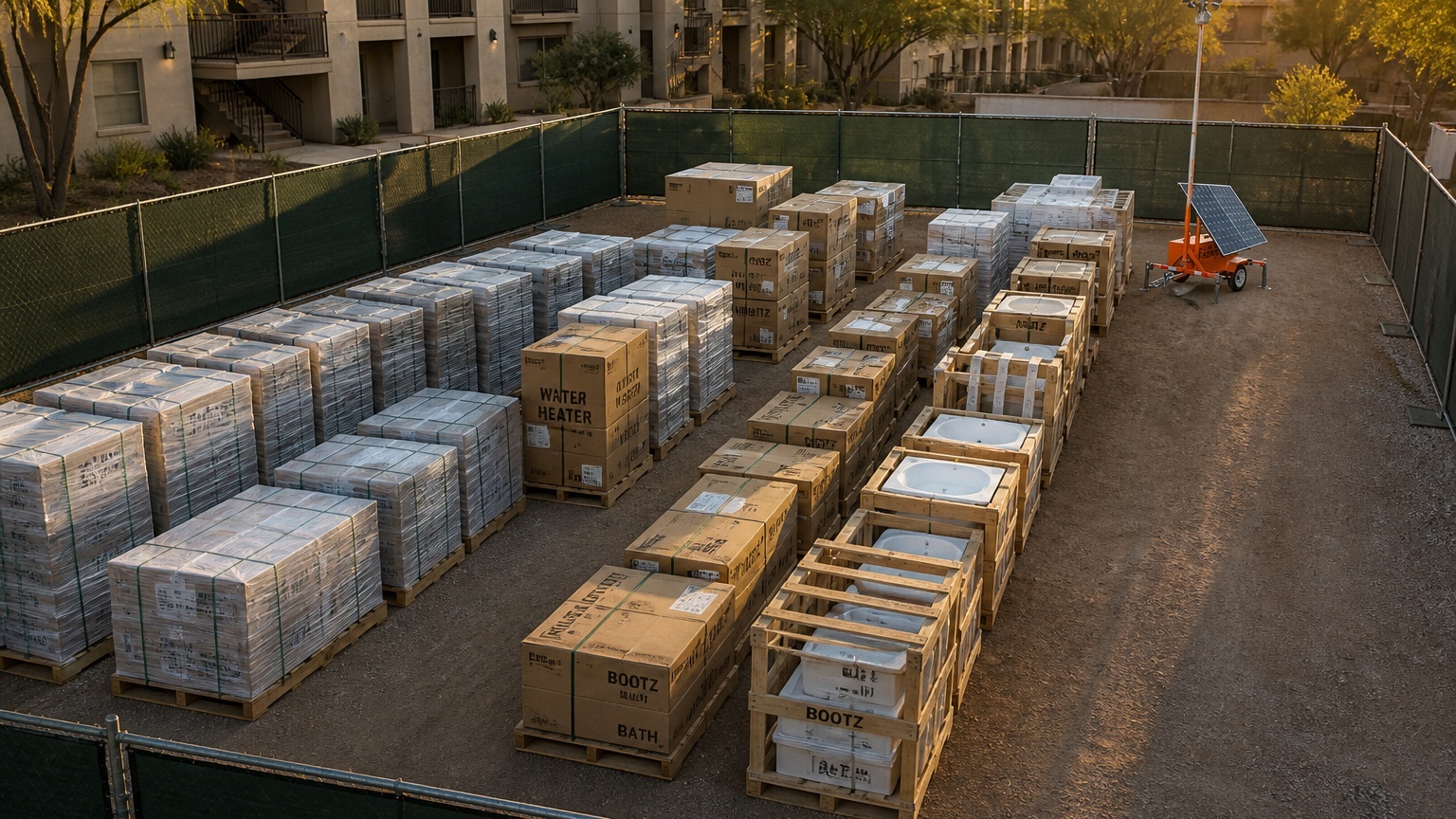
| Material or appliance staging area | Theft, damage, disputes about delivery timing, unsecured inventory. | Show the approach and exit path, not only the asset pile. |
| Mechanical or utility areas | Copper theft, water shutoff exposure, electrical risk, fire or service disruption. | Use tighter zones and clear escalation rules. |
| Roof access or service stairs | Unauthorized access to high-risk or restricted work areas. | Treat as restricted or emergency-only after hours unless specifically scheduled. |
Prioritize the access points that create the most risk
Not every route needs the same level of coverage. Focus first on areas where unauthorized entry could create theft exposure, resident safety issues, water or electrical risk, or a dispute that will be hard to reconstruct later. In most multifamily renovations, those areas include contractor gates, vacant wings, first-floor access points, service rooms, appliance staging, tool storage, roof access, parking used by crews, and any route that connects occupied areas with active construction.
Match each route to a time window
Each access point should have a clear status. For example, the west service gate may be contractor-approved from 6 a.m. to 6 p.m., a maintenance room may be emergency-only after hours, and a vacant building wing may be closed entirely unless work is pre-approved. When the rules are documented, the monitoring team can distinguish expected activity from suspicious movement much faster.
Define Who Is Allowed On-Site After Hours
Access control fails when too many people have informal permission to enter. Multifamily renovation teams should keep the approved after-hours list short and specific.
A good policy defines who can enter, why they can enter, which areas they can access, who approved the access, and how long the access window remains open. The access list should not be treated as permanent. It should change as trades finish, buildings turn over, and resident-facing areas reopen.
| Access category | Who may fit here | Rule to document |
| Always authorized | Property manager, project superintendent, emergency maintenance lead. | Name, phone number, normal route, and approved areas. |
| Scheduled authorization | Approved trade crews, delivery vendors, inspection support, specialty contractors. | Date, time window, company, contact, route, and work area. |
| Emergency-only authorization | Plumbing, electrical, HVAC, fire alarm, water intrusion, lock or safety response. | Trigger condition, emergency contact, allowed route, and required follow-up. |
| Not authorized after hours | Former vendors, completed trades, unscheduled delivery drivers, residents entering work zones. | Close or lock access, remove codes, monitor entry points, and escalate as needed. |
Do not rely on shared codes alone
Shared gate codes and lockboxes are convenient, but they are weak controls if they are not managed. Codes can be forwarded, photographed, remembered by former workers, or used outside the approved window. If shared codes are used, rotate them regularly, limit distribution, remove access when trades finish, and use camera verification at the points where codes are used.
Use Live Monitored Cameras to Verify After-Hours Activity
Cameras are most useful when they are connected to a response process. At an apartment renovation site, the system should help answer three questions quickly: Is someone there? Are they in an approved area? Is the activity consistent with the schedule?
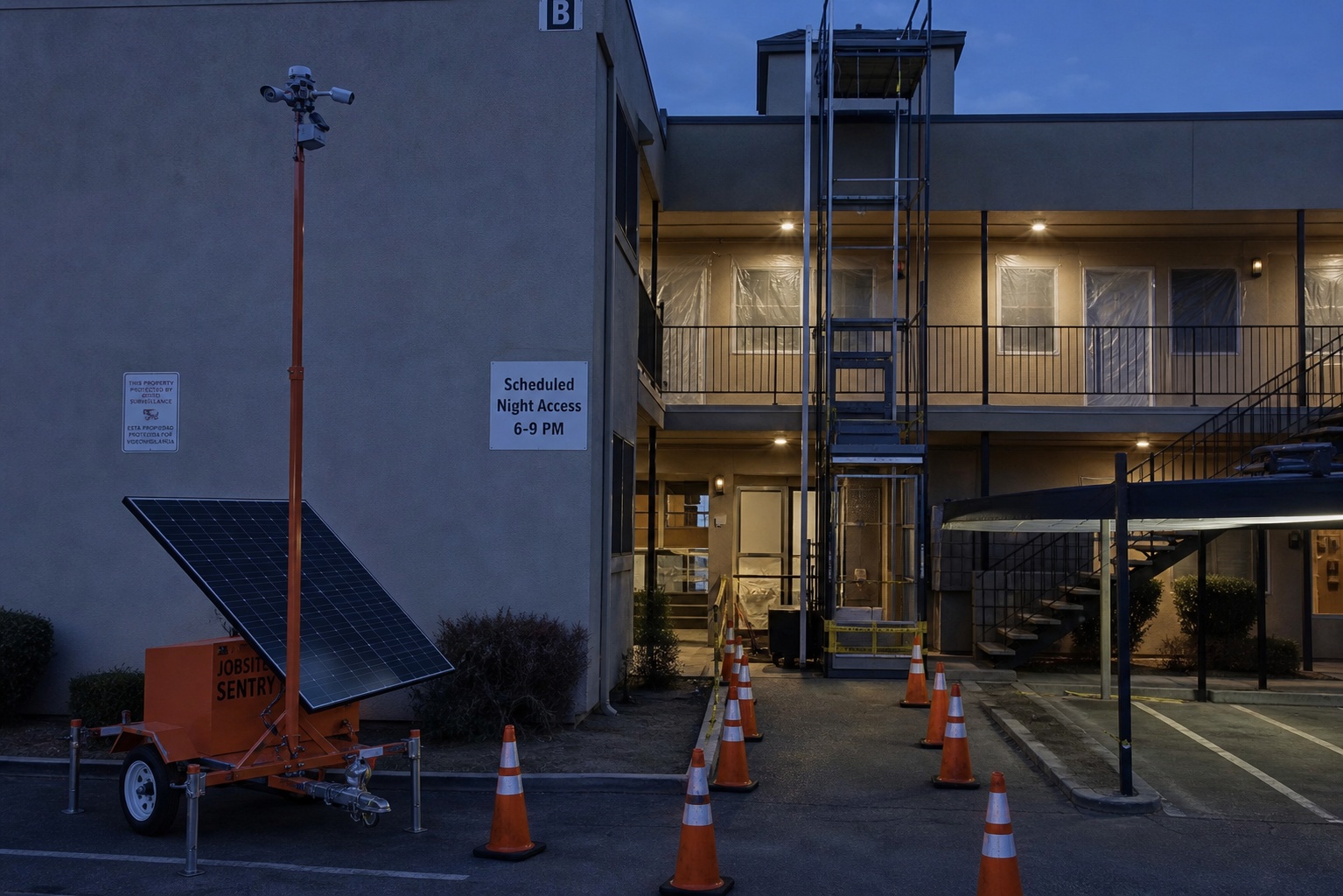
Jobsite Sentry supports this process with AI-powered detection, live human monitoring, PTZ camera views, two-way audio, playback, clip export, and mobile app access. For renovation sites without finished power or wired internet, solar-powered camera units and Starlink-connected options can help place coverage where the risk exists, not only where infrastructure is ready.
| Detection step | What happens | Why it matters |
| Detect | AI or analytics flag activity in a monitored zone during the approved schedule. | The team does not rely only on someone discovering the issue later. |
| Verify | A trained operator reviews the scene and compares it with authorized activity. | Scheduled work and suspicious entry can be treated differently. |
| Deter | The operator may issue a live audio warning when appropriate. | Unauthorized activity may stop before theft or damage progresses. |
| Escalate | The operator follows the written protocol for contacts or law enforcement. | Response is consistent and not based on guesswork. |
| Document | Clips, timestamps, camera views, warnings, contacts, and notes are retained. | The site has a clearer record for police, insurance, owner updates, and internal review. |
Customize monitoring for real renovation schedules
Apartment renovation schedules can change quickly. A building may be active late during inspection week, closed during a holiday weekend, or partially accessible during a resident return. Monitoring windows should match the current phase, not an old schedule. Review nights, weekends, holidays, shutdown periods, delivery windows, and approved late-work exceptions before each major phase change.
Create an Escalation Protocol Before the First Alert
After-hours access control is only as strong as the response plan behind it. If a monitoring operator sees someone entering a closed wing at 1:00 a.m., the operator should not have to guess who to call, whether to issue an audio warning, or when to escalate.
The protocol should be agreed before monitoring begins. It should include primary and backup contacts, the approved monitoring schedule, authorized work windows, audio warning rules, emergency maintenance rules, law enforcement escalation criteria, and clip delivery instructions.
| Protocol item | Decision to make before monitoring starts | Common mistake to avoid |
| Primary contacts | Who gets the first call and who is the backup? | Listing one manager who may be unavailable overnight. |
| Audio warning rules | When should an operator warn the person to leave? | Using warnings inconsistently or without site approval. |
| Law enforcement threshold | Which situations should be escalated immediately? | Waiting too long when theft, break-in, or safety risk is visible. |
| Emergency maintenance | Which emergencies are expected and who is authorized? | Treating all late activity as either suspicious or automatically allowed. |
| Video evidence | Who receives clips and where are records stored? | Exporting informal phone recordings instead of preserving usable clips. |
Keep escalation contacts current
Renovation teams change. Superintendents rotate, property managers take leave, emergency maintenance contacts change, and ownership representatives may be added during critical phases. Review the contact list before holidays, weather shutdowns, building handoffs, and any phase with planned after-hours work.
Plan for Exceptions Without Opening the Site to Everyone
Renovation work rarely follows a perfect schedule. Deliveries run late, water leaks require emergency access, utility shutdowns shift overnight, and vendors may need to protect fresh flooring or finish a unit before a resident return.
The answer is not to leave codes active for everyone. The answer is a specific, temporary, documented exception process.
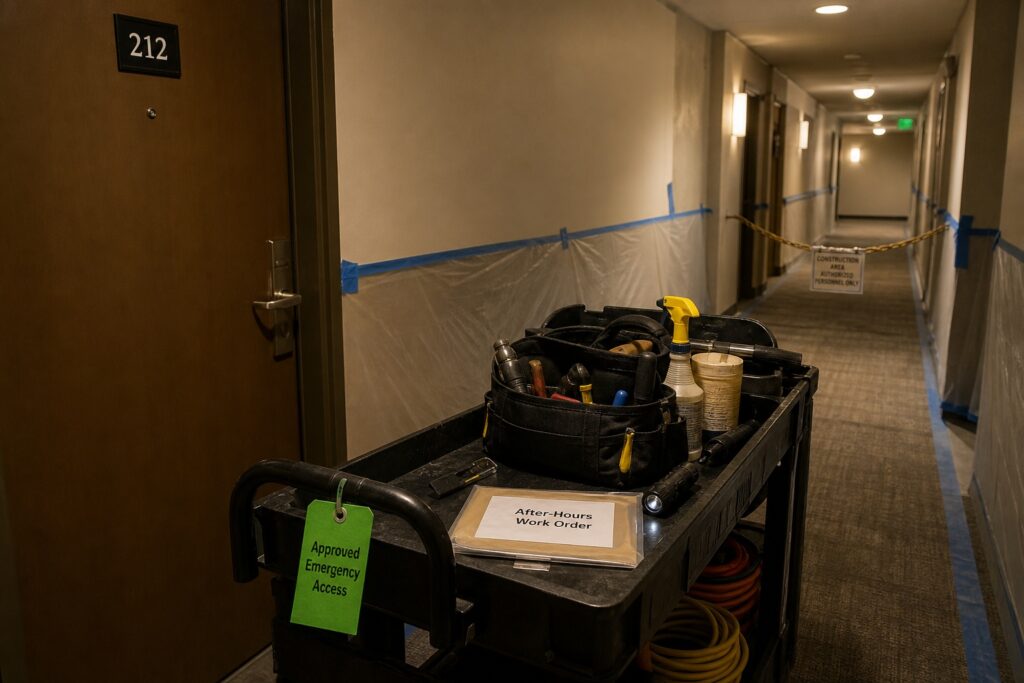
Each exception should state who is entering, which company they represent, the approved time window, the exact area they may access, the person who approved the entry, and whether monitoring operators should expect activity in that zone. If the event is not documented, it should not be treated as open permission.
Control after-hours deliveries
After-hours deliveries can create access risk because drivers may not understand renovation boundaries. Materials may be placed in unsecured areas, doors may be left open, or delivery vehicles may block resident routes. If a late delivery is unavoidable, define the drop zone, entry route, contact person, and camera coverage before the driver arrives.
Handle emergency maintenance separately
Emergency maintenance should not be handled like ordinary contractor access. A technician responding to a water leak may need immediate entry, but that does not mean broad access to construction storage, vacant units, or contractor parking. Use a separate emergency rule so resident needs can be handled without weakening the renovation boundary.
Use Video Evidence to Improve Accountability
Good access control creates a record. If an incident occurs, the team should be able to review what happened, when it happened, who was notified, and what action was taken.
The Jobsite Command Center supports live viewing, playback, PTZ controls, two-way audio, multi-camera views, and clip export for authorized users. That documentation can support police reports, insurance claims, owner updates, vendor disputes, internal reviews, and future access-control improvements.
The most valuable review is not only a single incident. Repeated after-hours activity near the same stairwell, parking area, vacant wing, or delivery route may show that signage, locks, lighting, resident notices, code control, or camera placement needs to change.
| Record to preserve | Why it helps | Review question |
| Timestamped camera clips | Shows what occurred and when. | Did the video capture the approach, action, and exit? |
| Operator notes | Explains what was seen and how the event was handled. | Did the activity match an approved work window? |
| Audio warning record | Shows whether a deterrent step was taken. | Did the person leave after the warning? |
| Contact log | Shows who was notified and when. | Was the contact list current? |
| Access schedule | Provides context for authorized exceptions. | Was the after-hours activity documented before it occurred? |
How Jobsite Sentry Supports Apartment Renovation Site Access Control
Jobsite Sentry helps multifamily teams move from reactive security to active access control. Instead of discovering damage in the morning, project teams can monitor after-hours movement, verify events, issue deterrent warnings, and preserve documentation.
Mobile surveillance trailers and camera systems are useful for temporary, outdoor, and changing sites. They can often be deployed without permanent infrastructure, relocated as the renovation phase changes, and supported with Starlink connectivity where ordinary connections are not reliable.
Pricing and deployment timing depend on location, site conditions, equipment availability, monitoring hours, connectivity, and project scope. Jobsite Sentry advertises live video monitoring as low as $1.99 per hour and commonly promotes fast deployment, but current terms should be confirmed during a site-specific consultation.
What areas should cameras cover first?
Start with contractor gates, vacant building entries, material staging areas, first-floor breezeways, equipment parking, mechanical rooms, roof access points, exterior stairwells, delivery areas, dumpsters, and any route connecting resident spaces with active construction. A site survey can help confirm line of sight, lighting, safe equipment placement, connectivity, and the access windows operators should use.
Can the camera unit move as the renovation changes?
Yes. Mobile units are designed for projects where risk moves. As work shifts from one building, wing, courtyard, or parking area to another, camera placement and monitoring zones can be adjusted to support the current phase. Each relocation should include a fresh sightline, connectivity, and monitoring review.
A Practical After-Hours Access Control Checklist
Use this quick review before after-hours monitoring begins, before a holiday shutdown, before a resident return, or whenever renovation work moves to a new building or wing.
- Access map completed: all gates, stairwells, breezeways, vacant wings, delivery zones, roof access points, and resident overlap areas are marked.
- Approved users listed: always-authorized, scheduled, emergency-only, and not-authorized-after-hours groups are separated.
- Shared codes reviewed: old access codes are removed or rotated and access is tied to current project phases.
- Monitoring schedule confirmed: nights, weekends, holidays, shutdowns, resident returns, inspections, and late work windows are documented.
- Camera views confirmed: high-risk entry points, approaches, exits, and staging areas are visible at night.
- Escalation protocol approved: audio warnings, contact order, law enforcement criteria, and clip export rules are written down.
- Review cadence set: access rules and camera placement will be reviewed after each phase turnover or meaningful site change.
People Also Ask
How do you secure an apartment renovation site after hours?
Secure an apartment renovation site after hours by mapping all access points, limiting approved access to specific roles and time windows, locking or closing nonessential routes, using live monitored cameras at high-risk zones, documenting exceptions, and creating a clear escalation protocol for suspicious activity.
What areas should cameras cover at an apartment renovation site?
Start with contractor gates, vacant building wings, first-floor breezeways, exterior stairwells, material staging areas, equipment parking, mechanical rooms, roof access points, delivery routes, dumpsters, and transition points between resident areas and active construction.
Can contractors still access a renovation site after hours?
Yes, but access should be scheduled, approved, limited to specific areas, and communicated to the monitoring team before it happens. Open-ended after-hours access should be avoided because it makes unauthorized activity harder to identify.
Do mobile surveillance trailers need power or internet?
Not always. Jobsite Sentry offers solar-powered camera units and Starlink-connected security options that can support temporary or remote locations where wired power, wired internet, or reliable cellular service is unavailable, subject to site conditions.
What happens when a monitored camera detects someone after hours?
A trained operator can review the activity, compare it with the approved schedule, issue an audio warning when appropriate, notify designated contacts, document the event, and escalate according to the written protocol.
Download the Apartment Renovation After-Hours Access Checklist
Use this checklist to review contractor entry points, monitoring schedules, camera priorities, lockup procedures, exception approvals, and incident escalation steps before after-hours access becomes a problem.
Frequently Asked Questions
What is apartment renovation site access control?
Apartment renovation site access control is the process of deciding who can enter a multifamily renovation property, when they can enter, which areas they can access, and how after-hours activity is verified, documented, and escalated.
How fast can Jobsite Sentry deploy a mobile surveillance trailer or camera unit?
Deployment depends on location, site access, equipment availability, connectivity, and installation conditions. Jobsite Sentry commonly promotes fast deployment, but current timing should be confirmed during the site consultation.
Can monitoring hours be changed during the project?
Yes. Monitoring windows can be adjusted for nights, weekends, holidays, shutdowns, delivery windows, phased turnovers, inspections, resident returns, and special after-hours work.
Can site managers view live video from a phone?
Yes. The Jobsite Command Center and mobile app support live view, playback, PTZ controls, two-way audio features, multi-camera views, video export, and remote site management tools depending on the system configuration.
Can AI distinguish between real threats and false alarms?
AI detection can help classify activity such as people, vehicles, equipment, and materials. Live human monitoring adds verification so operators can reduce unnecessary escalation from wildlife, wind, lighting changes, or approved activity.
Are there setup fees, data fees, relocation fees, or long-term contracts?
Fees and terms depend on project scope, equipment, connectivity, monitoring schedule, and relocation needs. Jobsite Sentry promotes transparent pricing and no long-term contract messaging, but current terms should be confirmed during consultation.
Conclusion: Control Access Before It Becomes an Incident
After-hours access control at an apartment renovation site is not about blocking every person from the property. It is about knowing who is allowed, when they are allowed, where they are allowed to go, and how the team will respond when activity falls outside those rules.
The strongest plan combines a clear access map, role-based permissions, scheduled work windows, live monitored cameras, AI detection, two-way audio, mobile app visibility, exportable video evidence, and a current escalation protocol.
Jobsite Sentry helps owners, property managers, and contractors protect apartment renovation sites without relying on passive cameras or unmanaged access codes. If your project has after-hours access risk, start with a site-specific plan before the next incident happens.
| SCHEDULE A JOBSITE SENTRY ACCESS-CONTROL REVIEW Need help securing a multifamily renovation site after hours? Jobsite Sentry can review your property layout, identify high-risk access points, recommend camera placement, build monitoring schedules, and help define an escalation protocol for unauthorized activity. |
Related Jobsite Sentry Resources
- Security camera trailer rental for construction and temporary sites
- Starlink remote construction security
- Jobsite Command Center camera monitoring
- Solar-powered security cameras without power or internet
- Mobile surveillance trailers for vacant properties
- What happens after a jobsite incident and why video evidence matters
- Contact Jobsite Sentry for a free site survey
Source References
- Jobsite Sentry: Security Camera Trailer Rental
- Jobsite Sentry: Starlink Remote Construction Security
- Jobsite Sentry: Jobsite Command Center
- Jobsite Sentry: Solar-Powered Security Cameras Without Power or Internet
- OSHA: Accident Prevention Signs and Tags
- OSHA: Signs, Signals, and Barricades
- CISA: Physical Security Resources and Security Planning Workbook
- National Institute of Justice: Digital and Multimedia Evidence